
Author: Dr Anshuman Karol, Dr Rabi Raj and Sowmia Philip | 02-Dec-2025
.jpg)
Across India today, a major shift is taking place in how universities think about knowledge, learning, and their role in society. The National Education Policy 2020 calls on higher education institutions to step outside their walls and engage deeply with communities, encouraging experiential learning, service-learning, and socially connected research. The UGC Guidelines on Fostering Social Responsibility and Community Engagement in HEIs reinforce this vision, emphasising that universities must actively collaborate with local communities, treat them as equal knowledge partners, and make field-based learning a core part of academic life. This idea found powerful expression in Jodhpur during a recent workshop on mapping traditional water bodies, organised by PRIA in partnership with Jai Narain Vyas (JNV) University, Jodhpur and the Jodhpur Municipal Corporation. What unfolded over two days was far more than technical training, it became a living demonstration of why community- university partnerships matter and how they transform research, learning, and local action.
.jpg)
In the arid landscape of western Rajasthan, Jodhpur’s water heritage, its ponds, baoris (stepwells), jhalras (rectangular or square-shaped pools with steps) and nadis (small village ponds or natural depressions in the landscape) has supported life for centuries. Yet much of this knowledge is not recorded in official documents or academic texts. It lives in the memories of community elders, in everyday routines of women managing water, and in the stories families pass down through generations. Students who joined the workshop quickly discovered that they were not simply going into the field to ‘collect data’, they were entering a community archive of lived knowledge. A student captured this realisation
“Mapping is not just technical work, it is about understanding culture, history, and communities’ spiritual, social and cultural relationships with these water bodies.”
This shift in perspective is at the heart of community-engaged research. It transforms water bodies from structures on a map into living ecosystems shaped by people, climate, rituals and memory.
The workshop brought students, community women, faculty, and heritage experts together in dialogue. The inaugural presentation on Jodhpur’s water heritage, led by INTACH Jodhpur, opened participants’ eyes to the remarkable engineering and community cooperation embedded in these structures. But it was during the participatory sessions, transect walks, community discussions, historical and Vision mapping that the true value of community knowledge emerged. Women from different neighbourhoods spoke about how water use had changed over decades, how baoris once used for drinking now lie silted or polluted, and how seasonal rainfall patterns have altered the behaviour of water bodies. They also talked about the rituals and festivals that used to take place around the water bodies, and the sense of community these gatherings once nurtured. They pointed out that as the water bodies deteriorated, these shared cultural moments faded too. Their contributions were not supplementary, they became the foundation of the entire mapping process. One elder shared
“In the evening people sat here and talked. This place connected all of us.”
One of the most moving moments came when a group of community women reflected on their experience of being in the university, sitting alongside students and participating in the research as an equal partner.
“For the first time, we felt our experiences were valued. We realised our own knowledge can contribute to improving water resources.”
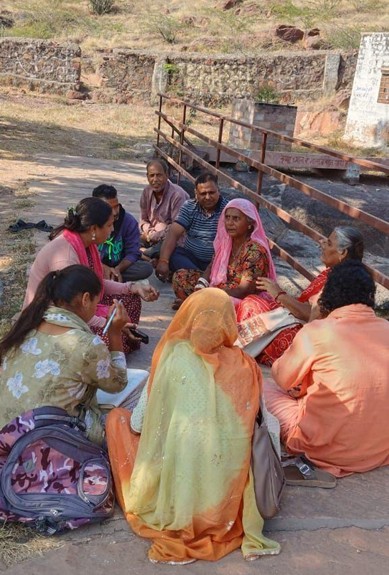 In that sentence lies the essence of participatory research, when community members see themselves not as subjects of study but as co-researchers whose insights shape the outcomes. This shift empowers communities to take ownership of the knowledge being created and strengthens their confidence to engage in future planning. When students and community women stepped into the fieldwork, the community’s role became even more central. Women led students through narrow pathways, forgotten corners, hidden jhalras and baoris, and places where water once flowed but is now blocked by construction or waste. The women introduced the students to community members for whom the water bodies had long been central to daily life. They described their everyday interactions with these sites and the many roles the water bodies played- providing drinking water, bathing and cleaning spaces, places for rest and conversation, and sites of deep spiritual significance. Many of these details would have remained invisible to students working from satellite images or municipal maps. As one student later noted
“Community guidance was essential; without them we would have missed many structures that are part of local history but invisible in maps.”
The field visit became a collaborative exploration, where GPS-based mapping, photographs, and technical observations were constantly enriched by community narratives, memories, and culturally rooted wisdom.
This is exactly what NEP 2020 and the UGC Guidelines envision, an academic process where students learn by engaging with real-world issues, listening to communities, and grounding their research in local contexts. This also revealed the gendered dimensions of water knowledge, with women offering insights on everyday water management, seasonal scarcity, rituals, and household water economy that are often absent from technical assessments. The workshop helped students internalise principles of ethical research as well, obtaining consent, respecting cultural sensitivities, and recognising the importance of returning findings to the community. They realised that research is not merely about documentation, it is about relationships, trust, and accountability.
.jpg)
The community’s involvement also deepened the quality of the research. Students learned to identify signs of siltation, observe encroachments, analyse catchment changes, and understand seasonal drying patterns, not just through technical tools, but through the lived experience of those who interact with these water bodies daily. Elders proudly recalled the effort they used to put in to haul water to their homes. They also talked about the refreshing taste of the water- something that they miss now. Some of them have seen the stepwells when the water receded and they described details about its architecture which could not be seen. Conversations with elders also revealed how biodiversity has changed, how water quality once influenced groundwater levels, and how climate variations have altered the behaviour of local ecosystems. These insights helped students build a more accurate and holistic picture of each site. By the time groups presented their findings, the richness of their data reflected this blend of community knowledge and technical skills. The maps, photographs, and observations were interwoven with narratives collected during transect walks and discussions. Faculty members noted how the students’ analysis had matured, moving beyond simple description to understanding the social, cultural, and ecological dimensions of each water body.
For community participants, the experience strengthened their connection to their own water heritage. Walking with students, interpreting local histories, and discussing climate-related changes helped many women articulate their own understanding of the water systems around them. A community member expressed what many felt:
“We now understand our water resources better and feel confident participating in future planning.”
This confidence and ownership are critical for any long-term rejuvenation effort. When communities become co-authors of knowledge, they also become custodians of action.
The experience at Jodhpur illustrates why community–university partnerships are not a peripheral activity but a vital part of the future of higher education. They create knowledge that is more accurate because it is grounded in lived reality. They build community ownership, which is essential for sustainability. They enhance climate resilience by acknowledging communities as frontline observers of environmental change. And they prepare students to be socially responsible professionals, deeply aware of their role in society. Most importantly, such partnerships reflect a shift in India’s higher education philosophy, one that sees communities not as beneficiaries but as collaborators, and one that understands that real learning happens when universities step into society and society steps into the university.
The Jodhpur experience demonstrates that when communities and universities walk together and engage in shared dialogue, they co-create new pathways of knowledge that are both socially meaningful and academically rigorous. This collaborative model offers a replicable approach for other cities and districts working toward climate-resilient, community-driven systems for water governance and heritage restoration. It reflects the future envisioned by NEP 2020, one where higher education is rooted in social responsibility, community participation, and experiential learning. This is the direction India’s higher education system must continue to strengthen and build upon.
A tribute to Comrade Damodar Thankappan, reflecting on over four decades of friendship, solidarity, and shared work with PRIA. From textile workers’ struggles and occupational health to construction workers’ rights and workers’ cooperatives, the blog celebrates his lifelong commitment to workers’ dignity, leadership, and collective action.
In this blog, Dr. Bandyopadhyay reflects on rethinking monitoring and evaluation in development practice. Drawing on his experience with participatory networks, he explores how organisations can move beyond compliance-driven reporting towards listening, collective learning, adaptation, accountability, and cultures that enable honest reflection.
This blog, by Dr. Anshuman Karol, explores why the future of higher education depends on community-engaged research, global collaboration, and knowledge democracy. It highlights how Community-Based Participatory Research enables universities and communities to co-create solutions for today's interconnected social and environmental challenges.
.png)
.png)