
Author: Felicity Lawrence | 30-Jun-2025
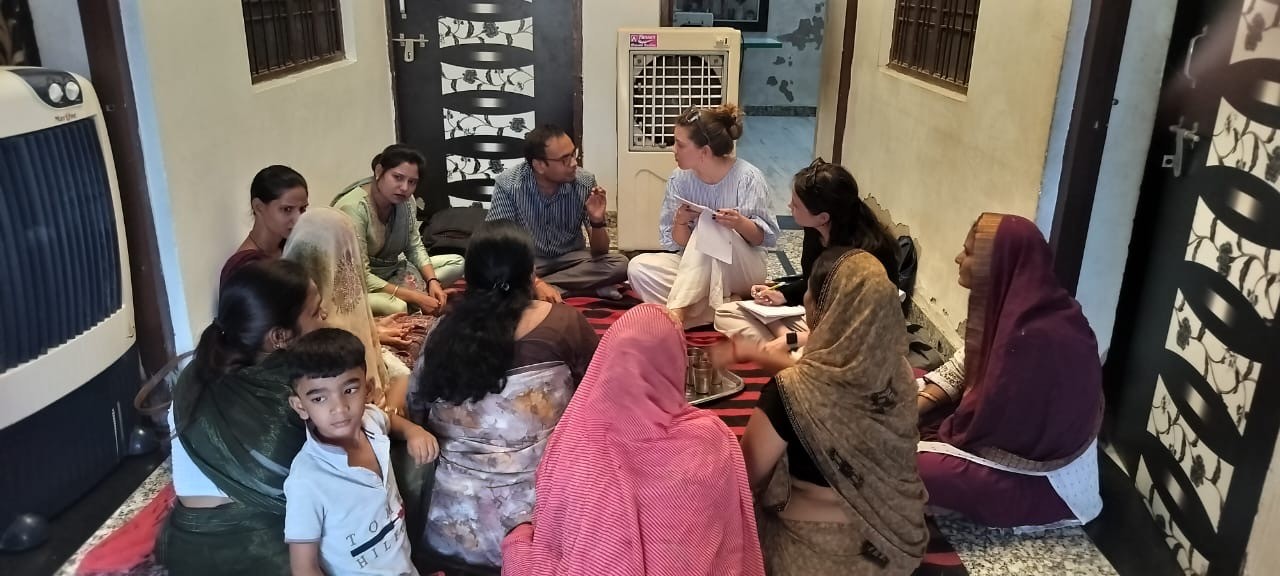
I spent six weeks in India as part of a research internship with PRIA, based in Delhi. I went with another student from my course to collect data for our master’s dissertations, focusing on issues around gender and water access. I was researching the lived experiences of water insecurity among women in informal settlements and exploring the potential of Self-Help Group (SHG) training programs as a form of community-led water governance.
Most of our time was split between working in the PRIA office during the week and travelling for fieldwork or weekend trips. It was challenging, intense, and completely different from anything I’d done before—but also incredibly valuable.
PRIA’s office in Tughlakabad Institutional Area became a sort of home base. Our weekdays in the office were a mixture of reading, writing, and preparing for fieldwork, while evenings involved walking around the small estate, grabbing dinner from Spices, the hospital canteen, and browsing the local corner shop.
Delhi itself felt like a sensory overload, with the constant sound of car horns blaring and cows, dogs, and monkeys on the side of every road. Coming from the UK, a country associated with the stereotype of loving to queue, the Indian driving culture was a shock to the system. At times, I almost felt like I was in a game of Mario Kart, especially on the occasions when sticking to the left side of the road seemed optional in the eyes of tuk-tuk drivers.
While our weekdays were spent in the office, on weekends, my friend and I tried to see as much of India as the two days would allow. We wanted to see more of India beyond the chaotic capital of Delhi. We managed to fit in tourist trips to several places: Varanasi, Jaipur, Rishikesh, and Agra, as well as a fieldwork trip to Ajmer. Through these weekends, we got to experience a slightly calmer, often more spiritual, side to India, taking in the gorgeous temples and forts in these cities.
A key part of the internship was a week of fieldwork in Ajmer, Rajasthan. During this trip, I focused on my master’s research, but also had the chance to see PRIA’s work first-hand. We shadowed the project leader as he undertook ‘stakeholder mapping’ for the next project phase, sitting in on several meetings where he spoke with various stakeholders about a proposed intervention, seeking their input and trying to secure their support. My friend aptly described his role as that of a ‘salesman’, constantly pitching the project to different people, trying to convince them of its importance and gain their backing.
In Ajmer, we conducted two focus groups and several interviews with key stakeholders. However, the conversations with women in the informal settlements have stayed with me most. We discussed topics like the position of women and water insecurity in their
communities. I was struck by a comment made by one of the women, who said, ‘No one faces a bigger challenge in life than a woman, even then she keeps on smiling’.
The strength of the women was so clear, especially as they spoke about their commitment to improving water access in the community. They explained the difficulties they faced even attending the SHG training, having to balance their household obligations with the PRIA workshop. One particular woman explained that she attended the full training days and then went home to prepare for her daughter’s wedding, all while taking care of her sick husband. She said, ‘Even after being so worried, there was not even a slight wrinkle on my face,’ and I think this quote encompasses the attitude of all the women I spoke to.
Reflecting on my time at PRIA, I can say that this internship was an invaluable experience in translating academic theory into real-world practice. It deepened my understanding of how complex social issues like water insecurity are not just about access to resources, but about navigating a maze of politics, bureaucracy, and entrenched gender roles.
The women I met in Ajmer were strong, resilient, and determined. Their ability to balance overwhelming responsibilities while seeking knowledge and advocating for their communities was so inspiring. It reinforced the importance of listening to the voices of those most affected by development issues and the need to design interventions that empower them, rather than impose solutions.
This internship has not only shaped my dissertation but also my broader understanding of community-driven change. It highlighted the role of local organizations like PRIA in pushing through the difficult but necessary work of creating lasting, grassroots solutions.
A tribute to Comrade Damodar Thankappan, reflecting on over four decades of friendship, solidarity, and shared work with PRIA. From textile workers’ struggles and occupational health to construction workers’ rights and workers’ cooperatives, the blog celebrates his lifelong commitment to workers’ dignity, leadership, and collective action.
In this blog, Dr. Bandyopadhyay reflects on rethinking monitoring and evaluation in development practice. Drawing on his experience with participatory networks, he explores how organisations can move beyond compliance-driven reporting towards listening, collective learning, adaptation, accountability, and cultures that enable honest reflection.
This blog, by Dr. Anshuman Karol, explores why the future of higher education depends on community-engaged research, global collaboration, and knowledge democracy. It highlights how Community-Based Participatory Research enables universities and communities to co-create solutions for today's interconnected social and environmental challenges.
.png)
.png)