
Author: Oilean Carter Stritch | 30-Jun-2025
One of the most significant moments of my working career so far is not anything that has garnered media attention, paid me well, or been well funded. It was a project that was completed with a minuscule budget, limited time, and a lot of listening. I was working with the start-up stage social enterprise Change Clothes Crumlin when I first entered the doors of this youth project in a disadvantaged area of Dublin, Ireland. The young people were initially resistant to my attempt to engage them. We were doing a project on the role of unsustainable fashion practices, and I quickly realised that while I was trying to teach them about the harms of unsustainable fashion, they knew already.
They told me many things they knew about unsustainable fashion, the harms to the environment, the people who make it, and to us wearing it. They also told me how they regularly buy from fast fashion sites and don’t want to be seen wearing an outfit twice. They told me how they know that unsustainable fashion is a problem and that they know better alternatives, such as second-hand shopping. They also told me how they don’t feel like they can buy second-hand because they don’t want their friends to think that they are poor.
After hearing this, I knew that the input that the young people were going to have was far more insightful and valuable than anything that I could tell them. I decided to let them have control of the project and budget, and I would simply facilitate. They could do whatever they wanted; if the young people wanted to glue all of the furniture to the ceiling, they could do it once they gave me sound justification. In the end, the young people decided to make a fashion magazine where they came to the Change Clothes studio, hired a photographer, styled second-hand outfits, and made second-hand cool. For a group that wouldn’t go near second-hand clothing before, there was competition over who got to take home certain pieces. The result was fun, creative, and was so could only be created by them. In the weeks and months after the project had concluded, the young people began using the studio on their own time, bringing their friends and families and integrating second-hand clothing into their way of living, now feeling comfortable to take climate action without stigma.
Taking part in this project allowed me to see a mindset shift happen in front of me. I am not a 14-year-old living with their circumstances and peer groups, and this project would have never happened had they not taken the lead.
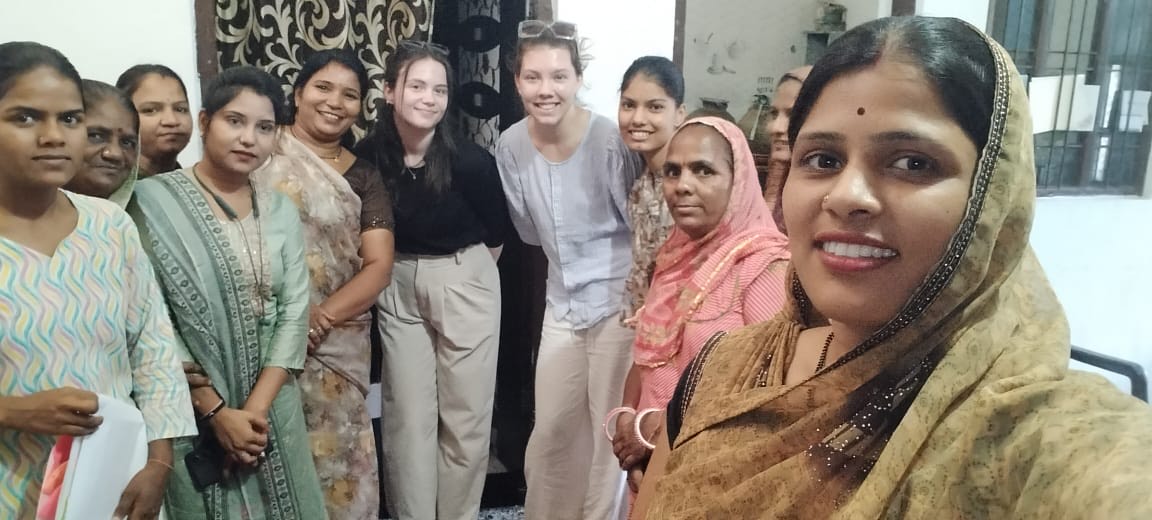
While, a completely different context, I brought this sentiment with me to India when beginning my time with PRIA. I came to explore the connection between climate change, increased heat and impacts on health for people in informal settlements, and no matter how many books I’ve read, how much research I’ve done etc., nothing I can say about climate change can be even a fraction as valuable as what the women in the informal settlements who experience it every day will have to say. Furthermore, the solutions to the problems that they face will not be found anywhere else but in their mouths.
Focus group discussions with women in informal settlements in Ajmer told me shocking things about how climate change impacts their lives on a day to day with temperatures in the last ten years increasing to over 42 degrees Celsius, how their health suffers year on year due to increases in rainfall and in turn disease, and how when calls for help are made to the government when sewage floods their homes they are not prioritised and dealt with adequately, leading to further risk of harm. While the women were not always aware why these changes were occurring, it was undeniable that they were, and that their lives were becoming more strained and difficult because of them.
So, after this, understandably, it was a great shock to me when interviewing government employees, the attitude was less urgent, with one even saying “climate change is not a problem [here]”. For employees I spoke to who did have a focus on climate, there was never a focus on informal settlements. When asked about how the authorities support those living in informal settlements during heatwaves, one official told me how their main priority is to make sure that informal settlements don’t form at all, and that when they do, police are sent in to monitor them. The government offers advice for people living in the area when heatwaves occur, such as avoiding outside work during the hours of 10 and 4; however, for people in informal settlements who rely on daily wage work, this is not an option, and their vulnerability heightens.
Over one billion people worldwide live in informal settlements, and the number continues to grow. This, coupled with an ever-diminished projection of worsening climate change and climate impacts, means that life is only set to become more difficult for these women. The women knew what could help them – more tree cover, less pollution, more prompt responses, and government help – but with no opportunity or willingness to be heard from those at the top, these solutions show no sign of coming to fruition.
The group of young girls from Dublin and the group of women from informal settlements in India, despite being from opposite sides of the world, have much in common. Both groups exist in a changing world, both experience multiple layers of marginalisation, and both hold the solutions to the barriers which they face in meeting their needs and taking climate action. Most importantly of all, both groups know their own experiences and hold their respective solutions in the face of an increasingly frightening climate crisis, and must be listened to and empowered to take action.
A tribute to Comrade Damodar Thankappan, reflecting on over four decades of friendship, solidarity, and shared work with PRIA. From textile workers’ struggles and occupational health to construction workers’ rights and workers’ cooperatives, the blog celebrates his lifelong commitment to workers’ dignity, leadership, and collective action.
In this blog, Dr. Bandyopadhyay reflects on rethinking monitoring and evaluation in development practice. Drawing on his experience with participatory networks, he explores how organisations can move beyond compliance-driven reporting towards listening, collective learning, adaptation, accountability, and cultures that enable honest reflection.
This blog, by Dr. Anshuman Karol, explores why the future of higher education depends on community-engaged research, global collaboration, and knowledge democracy. It highlights how Community-Based Participatory Research enables universities and communities to co-create solutions for today's interconnected social and environmental challenges.
.png)
.png)