
Author: Yedukrishnan V. | 26-Aug-2025
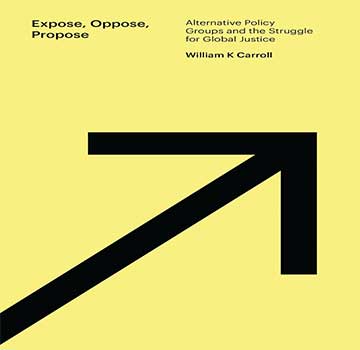
Amid widening global inequalities, ecological breakdown, and democratic backsliding, Expose, Oppose, Propose by William K. Carroll, published a decade ago, is a timely reminder of a weakening civil society. As the author observes, neoliberal capitalism reduces individuals to mere consumers in a marketplace where monetary power dictates value and voice. The book critically examines how Transnational Alternative Policy Groups (TAPGs) emerged as counter-hegemonic forces against an organic crisis where, as Gramsci said, the old is dying, and the new is struggling to be born. A recent discussion on this book I facilitated at PRIA, New Delhi, witnessed a much-needed collective reflection on the role of civil society and knowledge production in shaping a just future.
At the heart of Carroll’s argument is the idea that our current capitalist civilisation, which has attained an extensive global reach, witnesses a dual crisis – economic and ecological and needs to be confronted with a counter-hegemonic globalisation ‘from below’. The crisis manifests in persistent poverty, widening inequality, and an unrelenting climate emergency, all deeply embedded in the logic of capital accumulation. Capitalism’s internal contradictions—its tendency to overproduce, underpay, and extract—inevitably erupt into crises like the 2008 financial meltdown or the current ecological collapse.
To expose such injustices is to make visible the systemic roots of these crises. As the discussion emphasised, this means critically analysing dominant institutions—both state and civil society—that often fail the people they are meant to serve. Mainstream ‘think tanks’, for instance, had only constituted a ‘passive revolution’ and are increasingly viewed as a tool to maintain the global capitalist order. International NGOs, even the ones with good intentions, often replicate the structures of corporates when operating at scale. Their priorities, shaped by elite funders, dilute grassroots leadership and depoliticise struggles.
The author urges us to oppose these systems by challenging dominant ideologies and reclaiming democratic spaces through an ‘anti-passive revolution’. But this opposition isn’t always dramatic; it often happens through deep, sustained dialogue with communities and by co-creating knowledge rooted in lived experiences. One reflection raised in the discussion was that those most affected by inequality—marginalised and subaltern communities—are the ones who truly understand what needs to change. Therefore, any meaningful opposition must center its voices, not tokenise them.
And then comes the most vital part: Propose. While many talk about problems, Carroll stands out for his focus on alternatives. Drawing from a two-year study of 16 organisations worldwide, he highlights how TAPGs craft actionable solutions rooted in bottom-up,
movement-centered knowledge. These are not utopian blueprints but pragmatic frameworks that challenge neoliberalism and advance global justice through local struggles. As the author notes, TAPGs are ‘collective intellectuals of the global left’ and the task is to dialectically transform ‘common sense’ into good sense through new forms of knowledge and praxis.
PRIA (Participatory Research in Asia), the only India-based TAPG among the ten studied in depth, embodies this spirit. With one foot in liberal democratic processes and the other stepping toward radical democratic ideals, PRIA balances critical reflection with meaningful state engagement. As Dr. Tandon shared, some of PRIA’s most impactful work emerged through partnerships with the government, while its most incisive critiques were directed at the state—reflecting a center-left stance and pragmatic navigation of India's political contradictions, where “whatever you say, the opposite may also be true.” However, it is worth noting that the book was written under a pre-2014 political climate, when civil society still had more space to voice dissent.
The discussion among colleagues at PRIA also brought to light the crucial challenge of the NGOisation narrative. As NGOs scale up, they often lose their grassroots touch, becoming indistinguishable from service delivery agencies or even corporations. The group reflected on the need for ‘preventive measures’ to mitigate this colonising impact, while NGOs are forced to depend on hegemonic institutions for funding. The book reminds that justice globalism is a project in motion that requires political courage, collective dialogue and transnational solidarity between the Global North and South.
A tribute to Comrade Damodar Thankappan, reflecting on over four decades of friendship, solidarity, and shared work with PRIA. From textile workers’ struggles and occupational health to construction workers’ rights and workers’ cooperatives, the blog celebrates his lifelong commitment to workers’ dignity, leadership, and collective action.
In this blog, Dr. Bandyopadhyay reflects on rethinking monitoring and evaluation in development practice. Drawing on his experience with participatory networks, he explores how organisations can move beyond compliance-driven reporting towards listening, collective learning, adaptation, accountability, and cultures that enable honest reflection.
This blog, by Dr. Anshuman Karol, explores why the future of higher education depends on community-engaged research, global collaboration, and knowledge democracy. It highlights how Community-Based Participatory Research enables universities and communities to co-create solutions for today's interconnected social and environmental challenges.
.png)
.png)