
Author: Ram Aravind
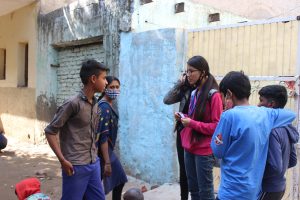
Social metamorphosis has its roots strongly embedded in local culture. However, the social- cultural milieu has done little by way of improving sexual well-being for India’s 253 million adolescent boys and girls. Conversations around sex is still considered taboo and archaic practices and attitude deprive young women of dignity during their periods. As we dive further into our exploration of social and cultural factors that influence adolescent heath in urban informal settlements through ‘Our Health, Our Voice’ study, it is vital that spaces for healthy dialogues around sexual health be realized. After all, participatory research isn’t just ‘ordinary research’. Traditionally ascribed to ‘conservative’ rural settings, hesitation and stigma attached to discussing sex and sexuality, however, extends beyond the geographical boundaries of India’s villages. Our young urban population is at a crossroads of a digital revolution, which affords much more information and awareness on a wide range of topics than its preceding generation. The virtual world affords them anonymity and provides a ‘space’ to be heard, but as teens struggle to cope with the different pleasures of ‘urbanisation’ and hesitancy in the ‘physical world’ to engage in topics (mis)construed as ‘uncomfortable’, sometimes the critical topics of adolescent growth tend to be brushed under the carpet. A 2015 study by Population Council and Indian Institute of Population Studies (IIPS) had estimated that half of the pregnancies in India are unintended.
For a researcher in the process of exploring health-seeking behavior of young people from low-income urban households (including children of migrant workers), my first set of apprehensions revolved around the following questions: How would the community take to questions regarding intimacy and sexual partners? How would the parents react if their wards were to be questioned about sexually transmitted diseases? How do we get the adolescents in the community to open up about other discreet harmful practices like tobacco consumption and drug abuse? The purpose of conducting participatory research is to encourage the community to become ‘active participants’ in knowledge creation and not ‘passive recipients’ of knowledge. However, it cautions the researcher against forming pre-conceived notions about community behavior. During the course of the participatory survey, along with the community and student researchers, I realised that adolescents were more than willing to let us into their lives and share intimate details about their health and well-being, as opposed to our initial clouded perceptions. They wanted to raise their voices and be heard. Their expression was powerful and, hence, they were better placed to articulate their needs, opinions, and aspirations. Social science researchers need to treat study participants as ‘partners’ and not ‘subjects. Adopting the patronising attitude of an expert researcher looking to extract information would have backfired, and prevented the community from trusting our intentions. To tell the boys that ‘innocently’ teasing women constituted abuse and to tell the girls that menstruation shouldn’t constrict social participation among other things wouldn’t have been possible if the researcher hadn’t adopted a participatory approach.
At the end of the survey, I can indeed declare that the researchers have succeeded in initiating conversations—not just with the youth, but also with parents, teachers and other community leaders. Over the course of the study, as the community and researchers work towards achieving a common goal, a shared understanding of the reality of adolescents will pave the way for a smooth path. An active peer group in the community was an idea born out of our interactions. We would indeed want that such spaces be created and sustained!
A tribute to Comrade Damodar Thankappan, reflecting on over four decades of friendship, solidarity, and shared work with PRIA. From textile workers’ struggles and occupational health to construction workers’ rights and workers’ cooperatives, the blog celebrates his lifelong commitment to workers’ dignity, leadership, and collective action.
In this blog, Dr. Bandyopadhyay reflects on rethinking monitoring and evaluation in development practice. Drawing on his experience with participatory networks, he explores how organisations can move beyond compliance-driven reporting towards listening, collective learning, adaptation, accountability, and cultures that enable honest reflection.
This blog, by Dr. Anshuman Karol, explores why the future of higher education depends on community-engaged research, global collaboration, and knowledge democracy. It highlights how Community-Based Participatory Research enables universities and communities to co-create solutions for today's interconnected social and environmental challenges.
.png)
.png)