Lack of oxygen in government hospitals, flooding, collapsing garbage dumps, derailed trains – these are a manifestation of decades of neglect, a quick-fix mind-set and no effort towards systemic governance reform. Without systemic governance reforms, New India will remain a mirage, says Dr Rajesh Tandon, Founder-President, PRIA
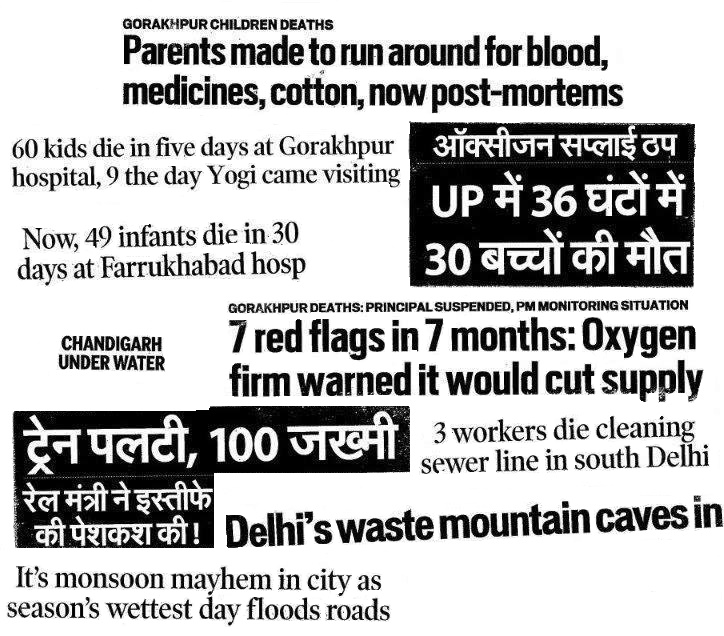
Over the past month, these are some of the headlines covered by India’s media:
- Children dying in government hospitals for want of oxygen, medicines and/or doctors in Gujarat, Uttar Pradesh, Rajasthan…
- Garbage dumps collapsing in Delhi, killing sanitation workers; hundreds of sanitation workers injured and killed in manholes and drains…
- Thousands of primary school para-teachers on strike, demanding regularisation; fired at by police when protesting...
- Metros like Mumbai, Bengaluru, Delhi, and many others flooded again in the monsoon… and frequent traffic jams as traffic lights stop functioning…
- Bumper crops of vegetables thrown away by farmers as they rot in the fields…
- Trains derailing almost every day; it is hard to keep count of the injured and dead…
All of the above incidents are inter-related. They are neither accidental, nor caused by an act of god. None of this is occasional; all of it has been happening every year, for years.
It is the consequence of a thoroughly broken, dysfunctional, corrupt and apathetic public system and institutions in the country. What is the manifestation of this ‘disruption’?
- Organisational structures, rules for decision-making and procedures for implementation are still continuing from the colonial era
- Number of laws, statutes and rules currently in force are inherently contradictory and practically unenforceable
- Institutional jurisdictions are over-lapping, muddy and weaken clear accountability
- Resourcing and staffing of institutions are inadequate and unrelated to mandates and targets
- Recruitment, postings and transfer of public officials are based on patronage and loyalty, not competence and performance
- Motivation and training of public officials is neglected, and no punishment is meted out for apathy, indifference, non-performance and corruption to any public functionary at any level
The current malaise is due to decades of neglect and denial. Many commissions and committees have made detailed recommendations on administrative reforms, police reforms, railway reforms, judiciary reforms. But no government, political leader or public actor has made any effort towards systemic governance reform. Instead, each successive government announces new schemes without replacing old ones; new laws and procedures are declared without ensuring coherence; and new institutions are set up without improving the performance of older ones.
Elections, vote banks and parliamentary majorities determine new public pronouncements weekly, which act only as patch-work to cover gaping holes. It has become fashionable nowadays to find a ‘tech’ solution for each ill of governance. Create an app, launch it with great fanfare, and pat ourselves on finding the ‘solution’. Technology can facilitate work; it cannot make people do their work sincerely.
Another trend these days is to call on people to participate. A slogan on Delhi billboards claims that citizens are fighting malaria. There is no mention of government cleaning garbage, filling potholes in roads or removing decades-old construction debris.
In a recent message, PM Modi asked the youth of India to become job-creators. When millions of youth are unemployed or under-employed in the country, and are desperately seeking a job, this additional burden of becoming an entrepreneur is unrealistic.
Over the past decade, a new ‘god of innovation’ has surfaced in India—‘jugaad’, which has been praised by many academics! ‘Getting things done by hook or crook’ is the essence of jugaad. It eulogises extra-legal actions of citizens and officials as ‘innovations’, since the system cannot be reformed. Perpetuation of a ‘jugaad mind-set’ is the antithesis to systemic governance reforms.
Thorough and systemic reforms cannot be substituted by short-term fixes. Systemic governance reforms require detailed, rigorous and long-term efforts, on course.
Without systemic governance reforms, New India will remain a mirage (whatever the deadline)!

.png)
.png)