
The launch of Swachh Bharat Mission - Urban (SBM-U) in 2014 ushered a tectonic shift in urban sanitation in India. It departed from the past strategies in several ways: first, it targeted all 4,041 Statutory Towns; second, it promised to provide subsidies to the construction of individual household latrines (IIHL). The objectives of the Mission included: (i) Elimination of open defecation; (ii) Eradication of manual scavenging; (iii) Modern and scientific Municipal Solid Waste Management; (iv) To effect behavioural change regarding healthy sanitation practices; (v) Generate awareness about sanitation and its linkage with public health; and (vi) Capacity augmentation for ULBs to create an enabling environment for private sector participation.
The Atal Mission for Rejuvenation and Urban Transformation (AMRUT) was launched in 2015 covering 500 cities across the country with over 100,000 population. The components of the AMRUT consist of capacity building, reform implementation, water supply, sewerage and septage management, storm water drainage, urban transport and development of green spaces and parks. Cities under AMRUT have also been encouraged to set up Faecal Sludge Treatment Plants (FSTPs) under the component of sewerage facility and septage management. Currently, 47% (Census 2011) of the urban households depends on onsite sanitation system, which is expected to increase with the construction of toilets under SBM-U. To address this gap, National Policy on Faecal Sludge and Septage Management (FSSM) was launched in February 2017. The policy aims to provide and strengthen safe faecal sludge treatment and septage management. SBM, AMRUT and FSSP together seek to provide a sustainable sanitation services to the urban population.
Despite significant political support and visibility, several systemic gaps exist in the implementation of sanitation programmes. One such concern is the gap between access to and usage of toilets where construction of toilets (IHHL and public and community toilets) have outpaced behaviour change. There have been concerns with context specificity of technology, quality of constructions, and sustainability of the movement. The ULBs at times adhered to a mechanical approach to target completions and did not pay much attention to behaviour change efforts. Concerns have also been raised about the deviation from norms essential to facilitate and sustain community participation.
The capacity of ULBs and other city authorities to implement and sustain sanitation movement with scale and pace is still limited. A systemic policy and concerted effort to develop institutional and individual capacity has been missing. The demand for capacity building is limited, sporadic and event based. Lack of credible supply side institutions that provide capacity building support is also a critical issue. Apart from the governments, a number of civil society organisations, international donors, corporate social responsibility programmes, private sectors, and academic institutions have joined the effort towards finding comprehensive and sustainable solution of India’s urban sanitation problems. However, more often than not, many such actors work in isolation missing out possible synergy in approach, target, and results.
Over the decades and more so in the recent years, plethora of innovations have been tried out by various actors. These relate to technology, financing, and community based solutions. Nevertheless, innovations can be of limited use and even be wasted, if these cannot be scaled up and made accessible to a greater number of communities. Many such innovations could not be replicated because of limited efforts towards dissemination, financing, and institutionalisation. A comprehensive, yet flexible framework is required to scale up innovations for better sanitation services.
Keeping this as background, a state level Conference on Partnership to Scale Up Innovative Solutions for Urban Sanitation was organised on 30 May 2018 in Jaipur, Rajasthan. It was organised by Participatory Research in Asia (PRIA) in collaboration with National Institute of Urban Affairs (NIUA), Centre for Development Communication Jaipur, Manipal University Jaipur, and the Institute for Development Studies, Jaipur.
Apart from an inaugural session, the conference was organised into four technical sessions. The first session discussed the use of service level benchmark (SLB) as a tool for performance enhancement of the ULBs and how efficient use of SLBs and appropriate financing can make sanitation services inclusive. The second session focussed on discussing the implementation challenges of achieving ODF and ODF ++ and identifying emerging innovative solutions. The third session deliberated upon implementation challenges for Solid Waste Management and emerging solutions from the cities. The fourth and final session explored how partnership and collaboration among various stakeholders can bring synergistic action towards inclusive sanitation (Annex.1: Programme Agenda).
The objectives of the conference were:
Since innovation, partnership, and capacity are intrinsically linked to ensure inclusive sanitation services, the conference was an attempt to bring together policy makers, researchers, and practitioners across governments, Urban Local Bodies (ULBs), parastatals, Civil Society Organisations (CSOs), academia, media, Corporate Social Responsibility (CSR) programmes, and representatives from the communities to gain insights on how a partnership approach can scale up innovations and capacity development. The representation was from within the state of Rajasthan and across the country.
Dr Kaustuv Kanti Bandyopadhyay, Director, Participatory Research in Asia (PRIA) welcomed the participants and set the stage for inaugural session of the conference. Shri Naveen Mahajan (IAS), Secretary, Local Self Government Department, Government of Rajasthan inaugurated the conference. The inaugural session was co-chaired by Dr Rajesh Tandon, President, Participatory Research in Asia (PRIA) and Prof Jagan Shah, Director, National Institute of Urban Affairs (NIUA).
Inaugurating the consultation, Dr Rajesh Tandon shared that Indian cities are experiencing accelerated growth. Hence, a comprehensive strategy is required for convergent work by multiple stakeholders. Although as a ‘sector’ CSOs have understood how to work through partnerships and cooperation in the rural, in urban we are yet to convene multi-stakeholder participation.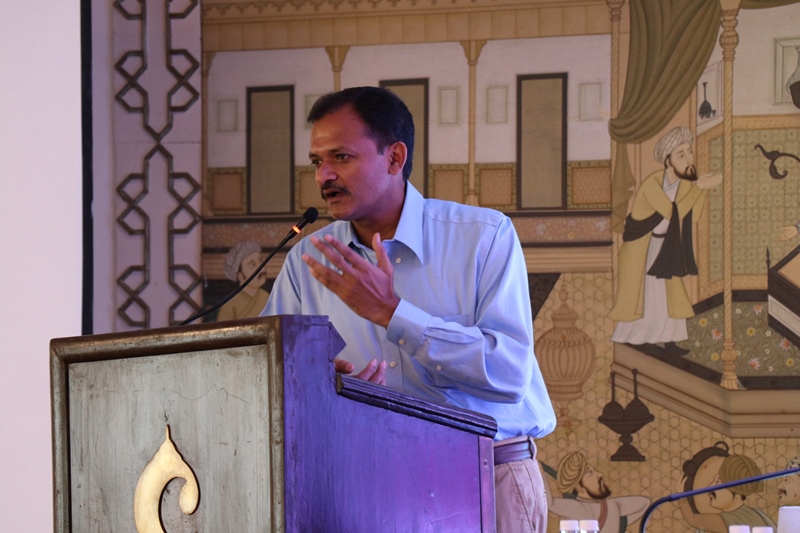
In the inaugural address, Shri Naveen Mahajan observed that although we are discussing innovations and scale up on urban sanitation, many cities are still struggling with fundamentals on a day to day basis. Based on recommendations from Asian Development Bank (ADB), sewerage interventions were approved in 15 districts of Rajasthan, to be laid in the city head-quarters. At present, the government has decided to take up the sewerage work in six more cities.
However, contracting of the sewerage work has some basic problems. Firstly, three different contracts are issued for construction of different parts of the sewerage line; additionally, these contracts do not include household connections to sewerage system. Hence, there are fundamental problems in the way in which the planning for such works are done. Moreover, the construction of sewerage disturbs the day to day life and mobility in the city. The problem is further aggravated because road restoration is excluded within this contract. Hence, a fundamental gap in the strategy disrupts the overall efficacy of laying sewerage lines in any city.
He informed the audience that globally the capacity utilisation of STPs is less than the optimal level. These are also cost intensive and have high CAPEX and OPEX. He questioned if we are such poor planners that before laying sewerage we do not even measure the volume of septage generation and collection as well as availability of minimum water supply i.e. at least 135 litres per capita per day. Since STP is a system of network, and availability of water is a prerequisite for its functions, if a city does not have enough volume, it would not be effective. Moreover, while the consultants and agencies such as ADB advise that every city should have a sewerage system; it fails to recognise that there are cities such as Makrana in Rajasthan where in summers water is available to the people at intervals of 7 days. In such places it is not feasible to lay a sewer system.
On solid waste management, he opined that the rate of composting in India is only at 11%. Total energy production of Rajasthan state through solar and wind energy is 22%. However, biomass component needs to be substantially improved. Hence, there is a long way to go in ensuring complete coverage of household level garbage segregation for which aggressive IEC campaigns are required. Yet another significant step is to convert the waste into energy. This is both a potential and an opportunity.
He suggested that every city, therefore, needs to have a different sanitation model. Places which face water scarcity must utilise the FSSM model. A mixed model can also be adopted. FSSM is neglected but it is low cost solution and also environment friendly as it restores the soil with NPK. There is a global debate on the effectivity and feasibility of decentralised FSSM and centralised STP. He further suggested that workshops and conferences should spark conversations around developing basic understanding of urban sanitation processes and enable participants to question and demystify the processes to develop better understanding.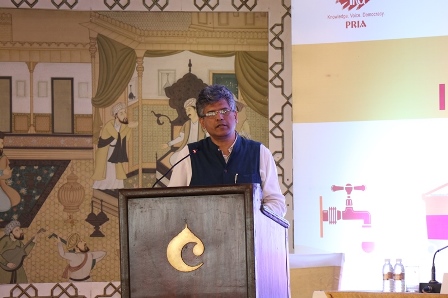
Prof Jagan Shah observed that innovation does not pertain solely to technology based solutions such as building an application. Modernisation of thoughts is equally important. In everyday life, we need to have the scientific temper. The mass movement generated through SBM needs to be scaled up. Thirty percent of India’s population resides in the cities. However, according to global parameters, we have urbanised to an extent of 80%. This is a huge challenge confronting the urban planners. In urban planning, nobody talks of informal settlements. Prof Shah quoted the Hon’ble Minister (Housing and Urban Affairs) Shri H S Puri ‘you ignore the informal sector at your own peril.’ Informal urban is huge and we need to think of ways to bring them access to both sanitation and health.
He further said that significant progress has been made on urban sanitation in Rajasthan. There have been many innovative solutions from not only across the country, but also from different cities in Rajasthan. PRIA has done significant work on citizen engagement. This is an important area of institutionalising innovations. It is important to learn and share these, and replicate these throughout the State, especially to other cities.
Making Sanitation Services Inclusive through Service Level Benchmarks and Financing ULBs
Mr. Rajesh Gupta, Joint Secretary, Rajasthan Fifth State Finance Commission began the session by sharing an analysis of service related data reported by various Urban Local Bodies (ULBs) under Service Level Benchmarks (SLB) in Rajasthan.
He marked out various inconsistencies in the service related data reported by ULBs as well as the difference between the reported data which claim services provided against the actual services committed. The data gathered for 191 municipalities exhibited inconsistencies in the way the format of SLB services declaration were recorded by the municipalities. In this exercise, Jaipur was an important example where the outcomes were regressive despite service provision. Therefore, the data generation has not been a reliable vantage point and needs to be monitored well.
He further remarked that there are massive discrepancies in the service level benchmarks shared by the municipalities as well as the inferences drawn out of these. Review of expenditure patterns of ULBs between 2015-16 found major gaps between basic services versus grant received. He expressed concern that the inclination has shifted to construction work instead of basic service provisioning, which must be the foundation of any kind of development work. The democratic decision making in ULBs with involvement of ward councillors needs to be improved.
Dr Sandeep Thakur,Senior Research Officer, National Institute of Urban Affairs (NIUA) focussed on ways to use data to improve services. For this, a user-friendly system which could generate awareness in the common people is important. The 14th Finance Commission’s Basic and Performance Grant extended to ULBs required them to score 60 marks to receive a Performance Grant. This year, the qualification required for ULBs to get a Performance Grant (along with the basic grant) from the government was reduced to 50 marks. In case of Rajasthan, only 22 out of 191 ULBs qualified for the Performance Grant of Rs.200.30 crore. Jaipur did not qualify. Major cities such as Ajmer, Banswara, Jhunjhunu were unable to generate adequate own source revenue. Similar insistence from the 15th SFC on performance as well as basic grant allocation will push ULBs to perform better. He stressed that ULB level decision making need to be decentralised and ULBs need to be made self-sufficient. This will help them adopt innovative solutions based on field realities.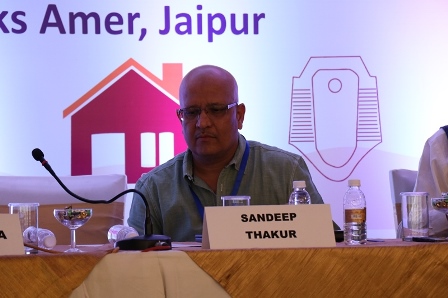
Prof Dinesh Mehta, Professor Emeritus, CEPT University, remarked on the SLB monitoring process, “what you cannot measure, you cannot manage; and what you cannot manage, you cannot plan.” He explained that SLBs do not necessarily depict an accurate picture as they do not take into account urban informality and aspects like on-site sanitation systems. He insisted on the need to differentiate service level performances between slum and non-slums areas as the lack of such analysis blankets the real and on ground performance. He said, “one needs to worry about services in the informal settlements and slums where the poor people reside”.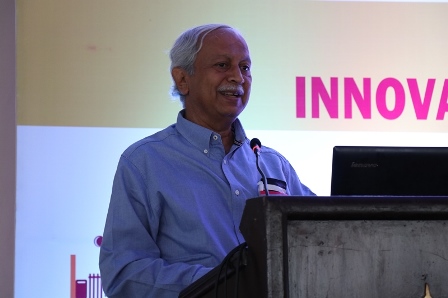
He argued that when it comes to onsite sanitation systems, the cities have achieved ODF. But the problem that has now emerged pertains to collection and treatment of faecal sludge. If cities are not doing that, and faecal waste is being disposed untreated, are we truly ODF? Hence, there is the need to focus on development through the involvement of the community itself and evaluate service provisioning in a larger frame. For example, availability of community toilets does not mean improved sanitation services but is rather the provision of only basic sanitation services. He advocated for the Performance Assessment System (PAS) framework which goes beyond SLB to measure informality (slums) as well as onsite situation.
Scaling Up Innovative Solutions for Achieving ODF and ODF ++
Prof Dinesh Mehta, Professor Emeritus, CEPT University Ahmedabad commended that SBM has begun a mass movement in the nation towards ODF. Though the target period was set till 2019, but it seems that the ways in which the work is happening across states, this target will be completed before time. A number of states including Maharashtra have been declared ODF. The next challenge is to ensure that the toilets are being used which is a part of ODF+ and that the faecal sludge is safely collected, treated and recycled which is ODF ++. This is important because when the septic tank truck dumps the sludge without any treatment it is equivalent to 300 people defecating in open.
Shri Amresh Sinha, Programme Manager, Consortium for DEWAT’s Dissemination Society observed that Faecal Sludge Management (FSM) is very important in the Indian context and sewerage systems may not be the only solution to India’s sanitation woes. The three important issues of scale, innovation and ODF++ need to be linked up. The ODF++ is a step ahead from ODF and ODF+ as it requires treatment and recycling of waste, but the challenge is to scale this up in 7000 cities of the country through innovative solutions.
Citing the current status of pollutant treatment, he shared that 67% pollution is caused due to pit and septic tank. 70% faecal sludge remains untreated. Overall, 90% of the pollutant is untreated which infects food and water cycle in turn affecting us.
Citing the successful implementation of FSTP model in Devanahalli, he commented on how it benefits both the farmer and labourers by providing nutrient rich compost.
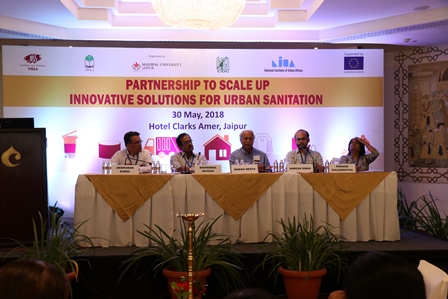
Dr Anshuman Karol, Senior Programme Manager, PRIA presented PRIA’s experience on citizen engagement in the city of Ajmer in Rajasthan. He shared that the Swachh Bharat Mission has been conceptualised as a Jan Andolon – People’s Movement; this extraordinary call for action goes beyond a “sarkari programme or scheme”. He further stressed that the most successful development programmes across the world had people at the centre participating in planning, monitoring and executing the schemes. People need government resources for development, but they also have their own resources – ideas, labour, commitment, and collective strengths – when these resources are leveraged, development outcomes become sustainable with people’s ownership. Hence, to make city governance inclusive and cities responsive, PRIA’s interventions in the city of Ajmer formed 100 Settlement Improvement Committees (SICs) of the urban poor in each informal settlement. These CSOs have more than 1900 members of which 48 percent are women. A city level forum of SICs (34 members and 14 member Executive Council) has also been constituted. This SIC Forum represents urban poor in CLAF of Ajmer SMART City Ltd.
In smaller cities, ward level data is either not available or not updated. The slums remain unrecorded in the municipal records. SBM is also based on the census data of 2011. In order to meet this gap, PRIA’s participatory survey ensured large coverage of informal settlements in the city. It covered 7,595 households of urban poor in 100 informal settlements. Additionally, a participatory sample survey of 6,220 households across 60 wards was undertaken to map the city.
These organisations of the urban poor empowered communities to negotiate access and delivery of basic sanitation services. At the ward level, micro planning was carried out.
The group collectively observed that despite having good ideas, defined parameters and implementation capacity we lack convergence between public and elected representatives as well as between political agencies and bureaucracy. How do we bridge this gap? Engaging citizens has remained a challenge.
Shri Bhupendra Mathur Chief Engineer, Department of Local Self Government, Govt. of Rajasthan, agreed with the fact that there is a need to bridge the gap between political agencies and bureaucracy. Even though acceptability of sewerage has increased in last 20 years, its implementation can happen only when the elected representatives and bureaucratic officials act together. He further marked that although 50 percent households in the state have individual household latrines (IHHLs), real time ODF is still far from completion. The remaining households are covered through community/public toilets. The target should be to achieve 80 percent IHHLs. He further stressed that the elected representatives are our biggest resource as they are the best communicators and have a huge role to play in mobilising people and bringing behavioural change at an individual level which is essential for achieving ODF, ODF+ and ODF ++.
He further observed that there is a need to standardise the cost of FSTP in terms of preparing DPRs for specific cities. The engineers need to know the actual amount of faecal generation in the city in order to be able to design relevant FSTP. He pointed out that survey done by PRIA especially related to Public/Community Toilets where all the toilets were geo tagged was important for communicating the real situation and such processes needs to be followed by others.
Shrimati Poonam Kulshreshta, State Project Manager, Centre for Advocacy and Research, informed the audience that Govt. of Rajasthan had issued multiple circulars to improve the implementation of SBM in the state. These circulars were developed after studying the ground level implementation issues and often updated. The implementing agencies therefore, must follow those circulars. According to one such circular each ULB is supposed to constitute Management Committees in all the bastis. The responsibility of maintenance of basic sanitation services is to be transferred to these Management Committees. CFAR has developed Management Committees and have developed a daily tracking format for sanitation services. The community’s challenge is to convert the problems into solutions through partnership with municipal officials. She pointed out that an important aspect to think about is the ways in which we can sustain the organisations of the urban poor.
Scaling up Innovative Solutions for Improving Solid Waste Management
Shrimati Meghana Malhotra, Deputy Director, Urban Management Centre, presented critical points of waste creation and management. She reinforced that in order to improve SWM, there is a need to move away from the “project mode” of service improvement to changing basic thinking of the city residents. India generates 35-40 million tonnes of waste each year which is expected to multiply five times by 2047. Are we ready for this increase? She highlighted the difference in the waste collection in big cities (70-90%) in comparison to smaller cities (less than 50%). Less than 30% of the solid waste is segregated and models of waste composting plants would not work unless waste is segregated at the individual household level. Without segregation at source, the consequent chain of segregated waste cannot be relied upon as it gets difficult to manage due to the scale and pace of things. She further explained that municipal solid waste collection in India is 80% but waste treatment is barely 20%.
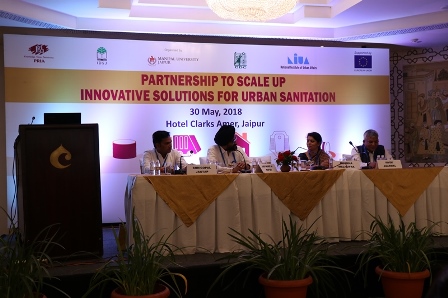
She advocated for the need of basic improvements in operations under SWM 2016 into the following categories:
Shri Shrigopal Jagtap, Manager, Basix, Municipal Waste Venture Ltd., shared in detail the example of Indore, where he talked about the importance and effectiveness of Integrated Solid Waste Management. This system brings in the idea of reuse and recycle through the efforts of the city dweller. The integration was conducted at a granular level where the youth, women, men and institutions of Indore took ownership of the city and made it a matter of pride to keep the city clean. “Darr se nahi, sharam se sudharte hain log” – he said, while explaining how citizens become responsible when their fellow citizens keep a check on their waste management and vice versa.
He explained that the profitable revenue can come from dry waste as “100% segregation of waste is the answer to all waste and littering related problems.” For this every city should be bin free, litter free and dust free. The only solution is the individual household segregation of waste and provision of adequate systems by the municipal corporation such as 100% collection of waste, waste treatment and recycling plants and other infrastructural modifications.
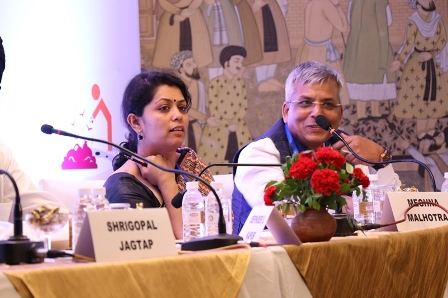
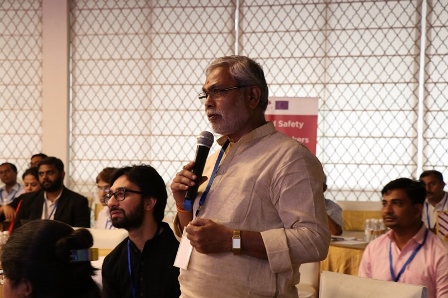
The session was concluded by Dr. Vivek Agarwal, Trustee Secretary, Centre for Development Communication. He said that solid waste must be managed with sustainability framework and must be seen beyond logistic management. The SDGs are to be the guiding framework. For example, displacing waste from point 1 to point 2 does not better the environment but only becomes a way of displacement and is therefore unsustainable. He insisted on the need for the shift towards micro planning – keeping in mind that different cities have different contexts and psychologies that affect how their waste travels. Dominance of corporate sector in waste collection is problematic and lacks a sense of ownership, unlike the traditional patron-client of jajmani system. The evolution of systems related to waste management were successful in scaling up but not in actually tackling the issues in a holistic manner.
Yet another important point is to talk about dignifying the segregation and collection of waste. Finally, he reiterated on the importance of ‘community connect’ and concluded by saying that there is a need to bring in the communities to a) dignify waste collection and b) practicing healthy waste management and monitoring for any positive change to take place.
Partnership for Impact and Sustainability
An important question that remained to be explored towards the end of the consultation was how partnerships between various stakeholders can enable innovative solutions to sustainable sanitation services?
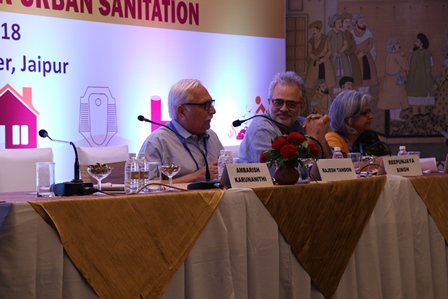
Shri Ambarish Karunanithi, Senior Research Associate, Centre for Policy Research, discussed the importance of multi-stakeholder partnerships for sustainable sanitation service delivery. He cited example of the project Nirmal from Dhenkanal and Angul in Odisha. He emphasised the relevance of a sanitation circular economic model where multiple partners cater to the different aspects of a project for its holistic implementation. CPR partnered with Dept. of Housing and Urban Department, Government of Odisha and Practical Action as implementing partners; E&Y as technical support partners; and Bill and Melinda Gates Foundation and Araghyam, Bangalore as funding partners. Such a crosscutting collaboration between government, civil society and corporate institutions ensured that technical, legal as well as contextual aspects of the project evolved and resulted in not just better service delivery and on-site sanitation management but also identification of 300 families of manual scavengers for rehabilitation and technical skill training. He emphasised on the need to innovate viable revenue models for any project to be successful and the significance of a multi-stakeholder approach to better sanitation as there are opportunities and challenges to tackle. The challenges such as persistence of manual scavenging that depreciates the demand for mechanical FSSM models, lack of accountability and capacity at ULB level, and issues of cost recovery require partners from different fields of expertise to come together for a successful intervention. He discussed, how the project was looking into the sustainability aspect by linking the products such as manure, created from the Faecal Sludge Treatment Plants in the two pilot cities with other industrial players.
Prof Shobhita Rajagopal, Director (Officiating) and Associate Professor, Institute for Development Studies, Jaipur highlighted that in the domain of sanitation for the urban poor, there are multiple challenges especially marked by systemic and structural issues. Amongst the urban poor, women are further overburdened. How do we feature issues of women in the planning process? For instance, menstruation, and sanitation combine to ensure menstrual hygiene amongst urban poor women. In the sanitation value chain, the gender lens towards making community toilets accessible to women and adolescent girls are not prioritised. These challenges must also form a part of the total information when planning for sanitation value chain. In their field experience women have complained about not being able to use community toilets because after 7 am the place has congregation of males, the premises have windows, and above all the community toilets close by 10 pm and are usually at a distance from the areas in which these women reside. Adolescent girls are unable to use these premises during menstruation.
Hence, there is a need to integrate a gender component in the sanitation planning. She further queried, how do we ensure level playing field for community engagement? Does the state believe in taking community along? How is change to be sustained? How are community level groups to be empowered so that they may function independently?
Prof Reepunjay Singh, Professor, HCM Rajasthan State Institute of Public Administration, suggested that there is a need for bringing attitudinal changes and to develop a sense of responsibility amongst all the stakeholders. For this, capacity building trainings and exercises have been planned across multiple stakeholder level at the level of ULBs and state level officials. He shared various training and capacity building programmes planned for various ULBs.
The consultation was concluded by Dr Rajesh Tandon, Founder President, PRIA, by highlighting that the day long conversations could be captured as –‘sabka saath sabka vikas.’ He reiterated that sanitation is such an issue that if we leave any single stakeholder out, it will become unachievable. Cities are heterogenous and we need to build frameworks to work through the diversity. At present, the stakes of people in the sanitation value chain have not been developed. There is a need to figure out responsibilities at the city level. It is significant to note that if we strengthen local bodies, we will get local solutions.