India accounts for 90% people who practice open defecation in South Asia and 60% people in the world who practice open defecation. Many agencies in India in addition to the union Government and various state governments have been engaged in making India an open defecation free country for decades now. The Prime Minister in his Independence Day speech in 2014 announced the Swachch Bharat Abhiyan or Clean India Campaign and made a commitment to clean India by 2 October 2019, which happens to be the 150th birth anniversary of Mahatma Gandhi. To achieve what was committed, the Government of India has adopted a mission mode and launched the Swachch Bharat Mission (SBM). The expected expenditure on this mission is estimated at 10 billion US dollars over a period of 5 years. SBM gives incentives to encourage more people to come under sanitation facilities and promotes building and using toilets.
The Swachch Bharat Mission places importance on awareness generation and knowledge resource generation in the context of which Rapid Action Learning Unit (RALU) is a major component at the national, state and district levels. These learning units will focus on analysing various practices from all across the country and disseminate best practices in sanitation. They will also identify problematic areas so as to facilitate effective and efficient implementation of Community Led Total Sanitation (CLTS) in the country.
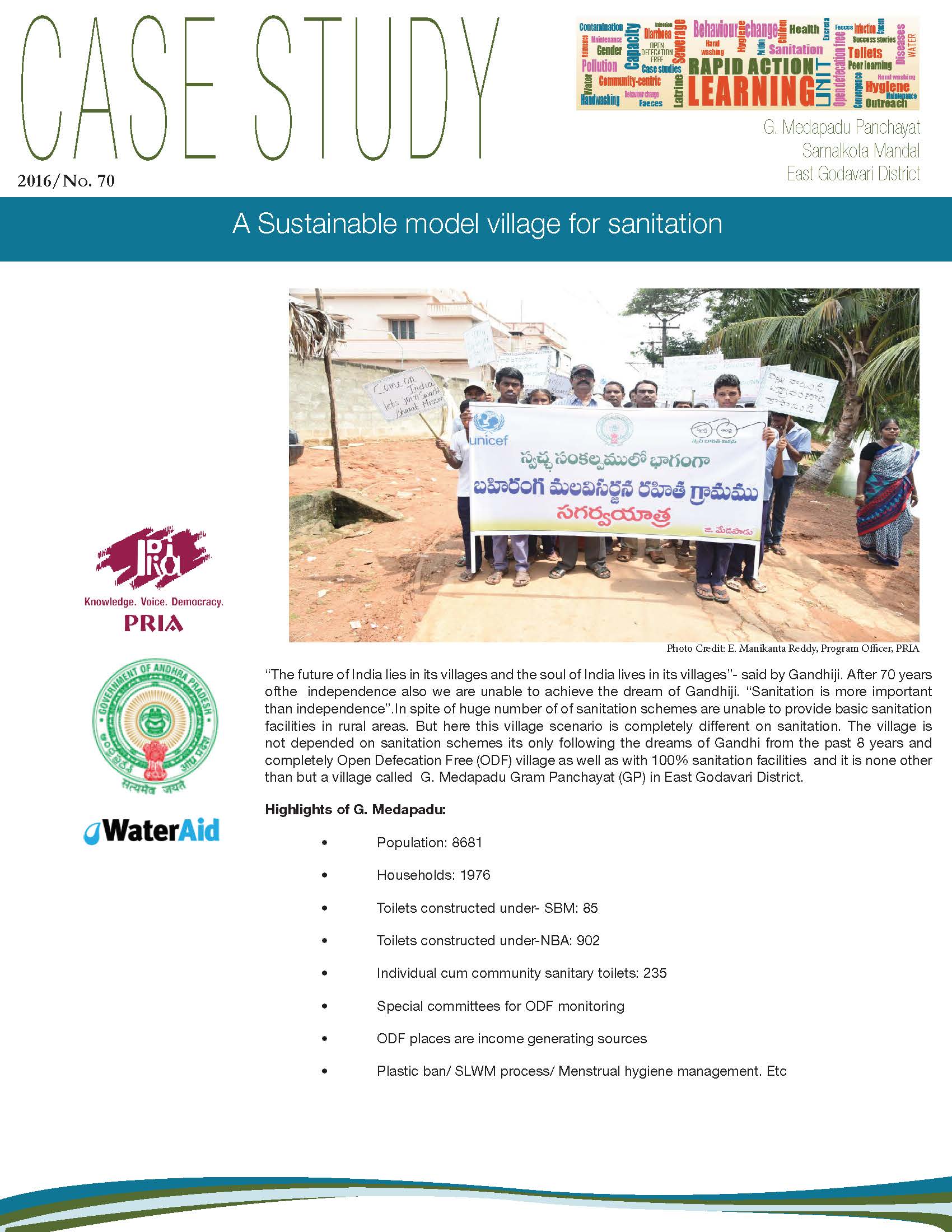
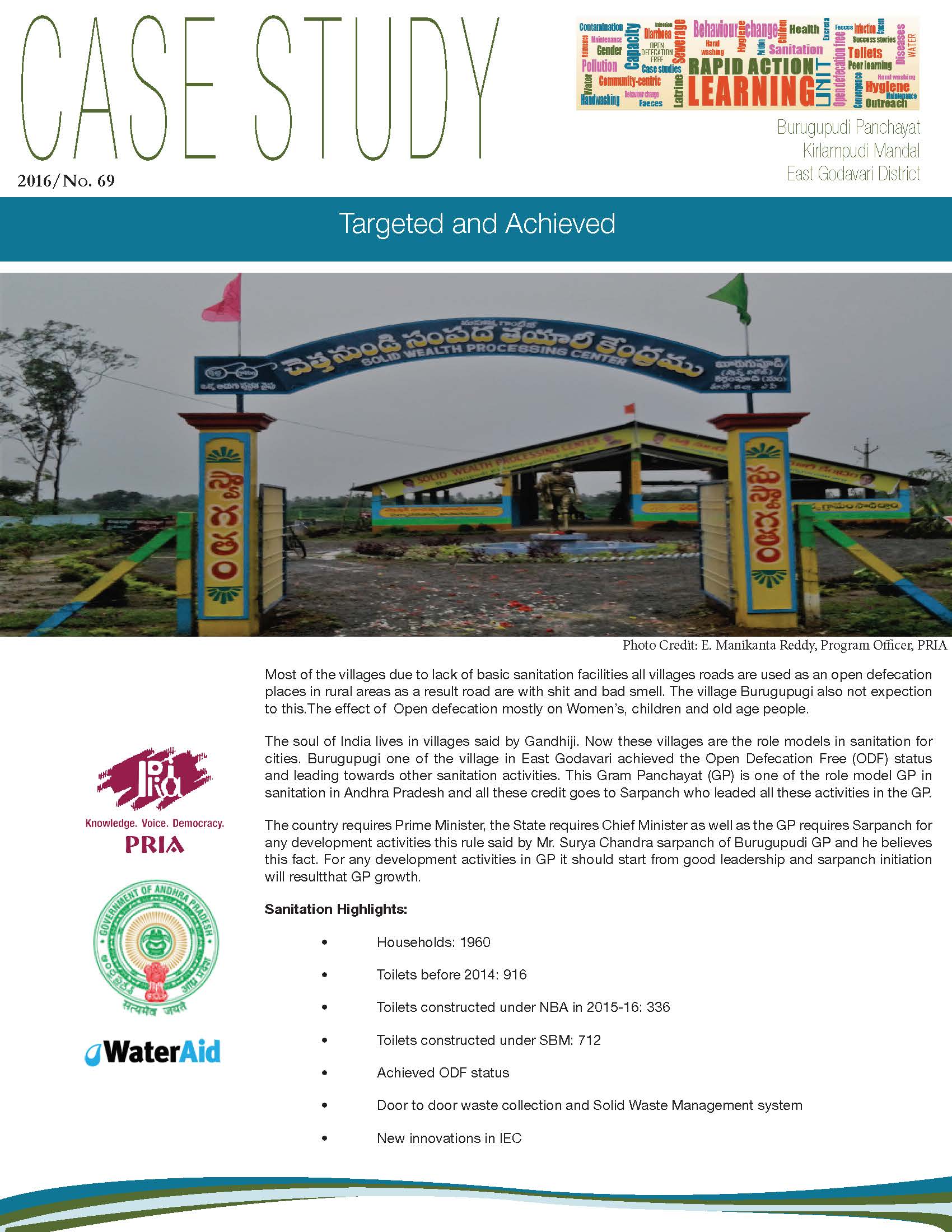
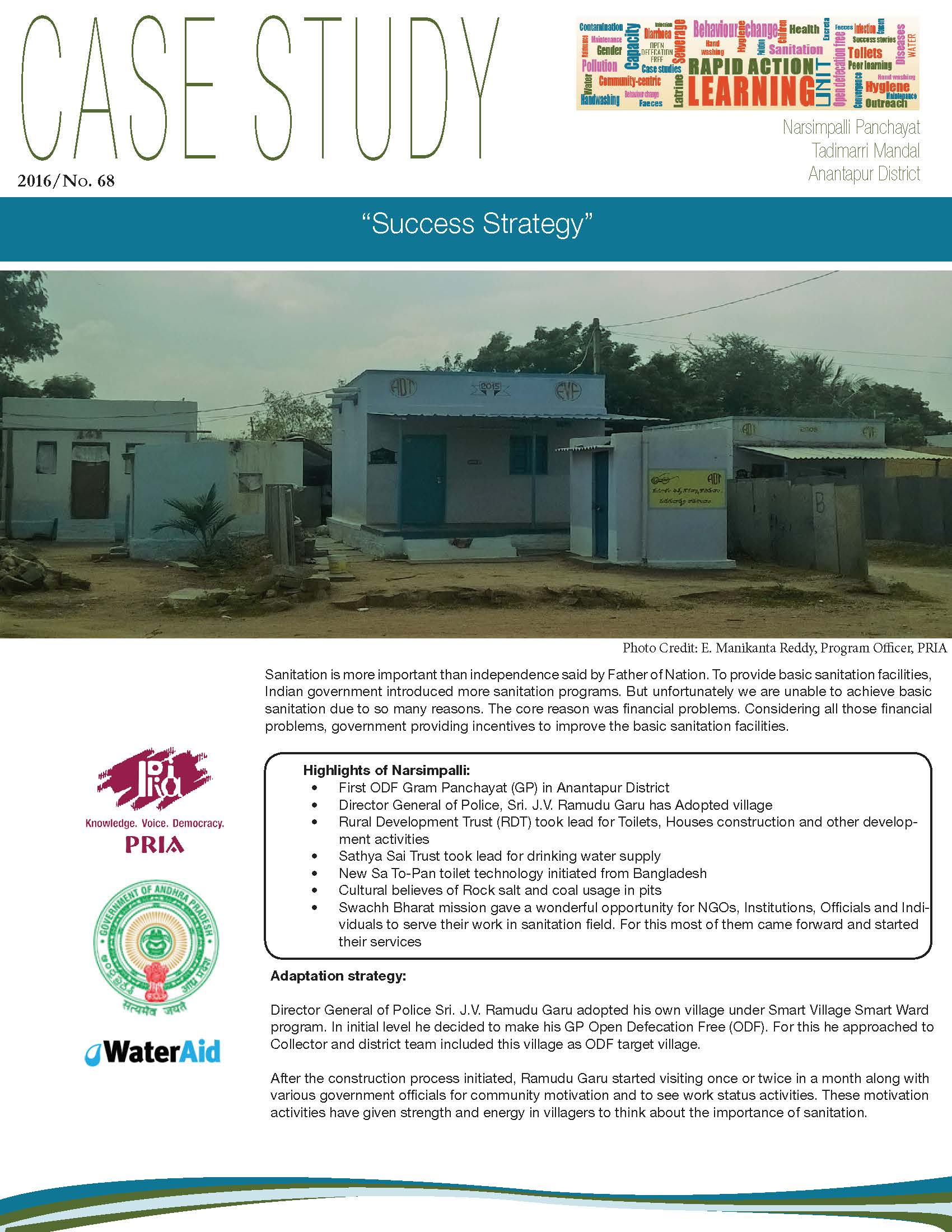
In collaboration with Water Aid, PRIA will establish and manage a Rapid Action Learning Unit in Andhra Pradesh with the objective of guiding the SBM initiative to achieve the goal of sanitation for all.
Objectives
(i) To operationalise RALU in Andhra Pradesh
(ii) To analytically document practices of SBM
(iii) To facilitate participatory monitoring of SBM
(iv) To conduct participatory research to understand the reasons for varied impacts of SBM
(v) To facilitate citizen-centric communication to enhance awareness on RALU and SBM
Specific Target Groups
Citizens of Andhra Pradesh, national and international researchers, government officials, NGO workers, policy makers, etc.
Geographical spread
All districts of Andhra Pradesh
Methodology/Key components
To achieve the desired objectives, RALU Andhra Pradesh managed by PRIA will undertake following sets of interventions:
a) Analytical Documentation: A large number of stakeholders have been and are currently engaged with sanitation efforts. They follow certain practices which are quite innovative and successful. There are also some interventions which have been utter failures. Analytical documentation of these practices will be great learning for current phases of SBM. Such practices will be identified directly by PRIA and through partners, communities and the government.
b) Participatory Monitoring: Any evaluation by primary stakeholders has always been found more useful. Citizen monitoring is different from administrative monitoring of a programme. It provides real time and on-the-ground information on problems in programme delivery. Since SBM (Gramin) is being implemented in about 18,000 villages across 13 districts in Andhra Pradesh, the scale of interventions is quite large. Real time regular monitoring of such a big initiative will not be possible without collaborative effort among citizens and different government agencies. RALU Andhra Pradesh will facilitate such collaborative participatory evaluation of SBM for in-time and appropriate feedback to rectify problematic areas and scale-up good work. On the basis of community feedback, issues will be identified that emphasis behavioural change in communities and responsiveness and accountability of SBM workers.
c) Participatory Research for New Knowledge: Critical analysis of SBM systems and processes will be helpful in identifying the critical factors behind successes and failures of different ongoing initiatives and incentives. RALU Andhra Pradesh will conduct participatory research and analysis to find answers to unresolved questions and emerging trends. The research will also focus on the factors which lead to behavioural change in communities such as incentives, self-driven sanitation agenda, toilet subsidies, etc. RALU will also study inclusion issues and identify the critical factors behind exclusion of some communities, if any.
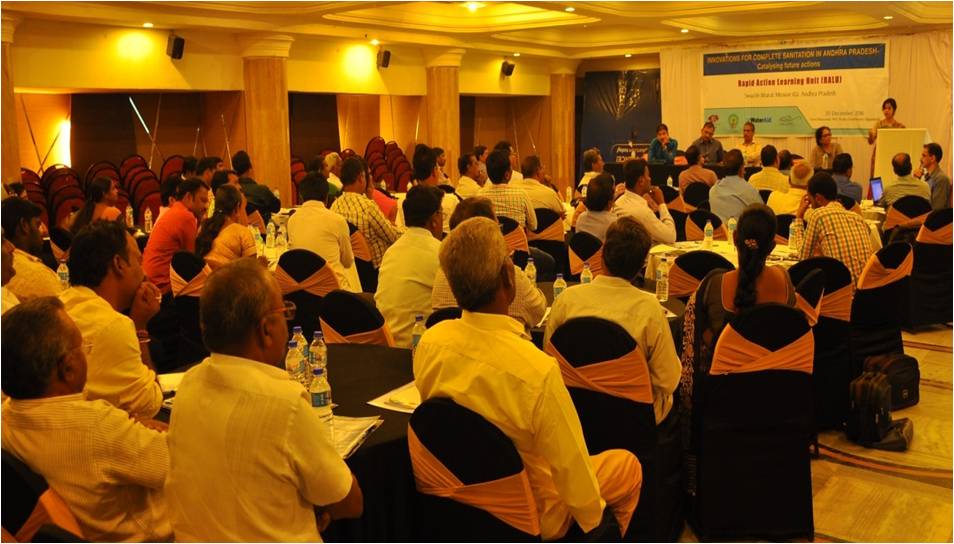
d) Citizen-Centric Communication: All information made available to and compiled by RALU will be systematized in usable forms for use by the citizens of the state. Communication will be through all possible modes (conventional and social media) to disseminate information to appropriate users. RALU will also convene regional and state level consultations to share learnings and progress in SBM. Such consultations will also help RALU generate additional inputs to improve implementation of SBM.
Key outputs/Deliverables
• Operational RALU
• Documented case studies from all districts of AP
• IEC material and resource kits
• Enhanced awareness and knowledge of key stakeholders
Expected Quantitative Impact
|
Key Results
|
Year 1 (4 months)
|
Year 2
|
Year 3
|
Year 4 (8 months)
|
|
No. of villages covered to study, analyse and identify issues related to ODF and other highlighted issues
|
30
|
117
|
117
|
50
|
|
Number of VWSCs interfaced
|
30
|
117
|
117
|
50
|
|
Number of WASH frontline workers contacted and their capacity needs highlighted in RALU documents
|
60
|
234
|
234
|
100
|
|
Number of health and nutrition frontline workers contacted and their capacity needs highlighted in RALU documents
|
60
|
234
|
234
|
100
|
|
Local governments (PRI/ULB) to be assessed/surveyed/information shared
|
30
|
117 PRIs
|
117 PRIs
|
50
PRIs
|
|
Mandal/Block Officials or Service Providers contacted as part of the assessment/research
|
39
|
39 Mandal officers
|
39 Mandal officers
|
13
Mandal officers
|
|
No. of research studies
|
1
|
2
|
2
|
1
|
|
No. of case studies
|
12
|
36
|
36
|
22
|
|
No. of stakeholder meetings on identified issues of SBM
|
4
|
5
|
3
|
3
|
|
No. of regional consultations on SBM
|
1
|
6
|
6
|
0
|
|
No of multi-stakeholder programmes at the state level
|
1
|
3
|
2
|
0
|
|
No. of national consultations on SBM
|
0
|
0
|
1
|
1
|
Year/Period
1 December 2015 to 30 November 2018
Client
Water Aid, India

 under SBM in Andhra Pradesh.png)