Dear Colleagues
Monsoon season has arrived early this year; while water is everywhere, another round of random reflections for your perusal:
- Most museums in UK are free for visitors. I enjoyed the wonderfully informative Aberdeen Maritime Museum learning about its connections to slave trade. Kelham Island Museum in Sheffield tells the story of steelmaking and its global trade connections. There is a donation box in each museum, with a suggested amount. By not having an entry fee, this policy enables families with less means to also learn and enjoy museums.
- Climate changes are real. One day in June, day temperature in London was higher than in Delhi. Built for cooler climate, most homes in and around London become unbearably hot when temperatures reach 30°C. Future research on impacts of heat stress may focus on London too?
- Aviation mishaps and accidents in air travels have been in the news more frequently of late, after the tragedy in Ahmedabad. Still, statistics show that air travel is the safest form of travel. That may have been true in the past, so low average numbers still. But, recent trends of enhanced air traffic, more airlines and planes, and newer airports are demanding improved technology, design, maintenance and staffing in the industry. Profits?
- In the mining region of Durham County in UK, the University and Durham Miners Association have had a long history of working together over nearly 150 years. This partnership dates to the early days of coal mining in the region, even before the University was authorized to award degrees in 1837. Even though coal mines are long gone, the annual Miners’ Gala in Durham recreates some of that excitement and culture.
- This is mango season in North India. India produces nearly half of global mango production. Mango is national fruit in India, Pakistan and Philippines; and mango tree is national tree of Bangladesh. It has been cultivated in South and South-East Asia for nearly 6000 years ago, though Portuguese colonizers gave this name around 15th century. As many orchards are being swallowed up by rapid urbanization, there is a huge reduction in the varieties of mangoes previously grown.
Stay well, sincerely
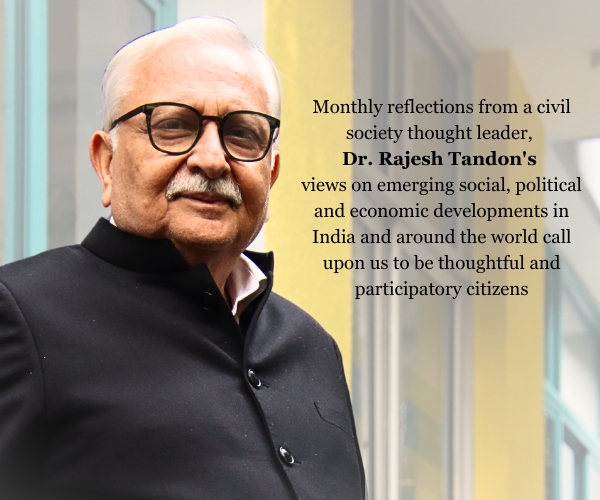
Dr. Rajesh Tandon
About the Author
A Ph.D. from Case Western Reserve University (Cleveland, USA) and an electronics engineer (IIT, Kanpur) with a graduation in management (IIM, Calcutta), Dr Rajesh Tandon is an internationally acclaimed leader and practitioner of participatory research and development.
His journey with PRIA started in 1982, as a young IIM graduate wanting to do more than just complete his PhD fieldwork.